
The Jesus Hoax: Was Jesus Really Special?


Over the last year, I’ve been teaching World Religions at a community college. The class is designed to provide a basic overview of the major religions that have dominated history for the last 3,000 years: Judaism, Christianity, Islam, Hinduism, Buddhism, Confucianism, Taoism, Shinto and Primal Religions.
The last time I dealt with all these religions at once was during my undergraduate education at Rice University where I majored in religious studies.
Teaching this material sparked a memory from my early 20s. I was sitting in my dorm room, studying for my Religion 101 final, when I asked myself a very basic question: Were the figures who founded these religions really as unique as they claim, or were they just men whose reputation metastasized over time as their influence grew?
For example, consider Siddhartha Gautama, otherwise known as the Buddha. The story goes that after 49 days of meditating under a Bodhi tree, Gautama, at the age of 35 in 528 BCE, became the first human to escape samsara (the continuous cycle of life, death, and reincarnation). This is why Siddhartha is imbued with the title of the Buddha, which means enlightened one.

Why do Buddhists believe that Siddhartha achieved enlightenment? First and foremost, because Siddhartha claimed he was enlightened. The secondary evidence supporting his claim would be his teachings. Siddhartha’s followers believed that his teachings could only have come from someone who had achieved enlightenment.
Yet, Siddhartha did not write down his own teachings. Tradition states that monks memorized his teachings through collective recitation, passing them down orally for approximately 400 years until they were written on palm leaves in Sri Lanka during the first century BCE.
This gap between the founder speaking the teachings and the disciples writing them down is consistent across every ancient religion. The founder’s teachings are transmitted orally over a period of time (often decades or centuries) and eventually committed to writing.
Below is a chart outlining the distance between the oral tradition of the founder (if there is one) and the written scriptures.
Religion | Founder | Birth | Death | Historicity | Scriptures (written after oral transmission) |
Hinduism | None | N/A | N/A | N/A | Rig Veda: 500-1000 years |
Judaism | Moses | 1391 BCE | 1271 BCE | Torah: 500-1000 years | |
Taoism | Lao Tzu | 604 BCE | 531 BCE | Tao Te Ching: 200-300 years | |
Buddhism | Buddha | 563 BCE | 483 BCE | Sutta Pitaka: 300-400 years | |
Confucianism | Confucius | 551 BCE | 479 BCE | Analects: 200 years | |
Christianity | Jesus | 4 BCE | 30 CE | Gospels: 40-70 years | |
Islam | Muhammad | 570 CE | 632 CE | Quran: 20-50 years |
This chart raises a critical question the followers of these religions often fail to ask about the transference from oral to written teachings: Was anything misremembered or changed along the chain of transmission?
Textual Criticism
One of the first things you learn when studying the Bible through the lens of religious studies is how the Bible was written.
The scholars who study the oldest known manuscripts of the Bible are known as textual critics. Their goal is to reconstruct the most accurate wording of the original biblical texts by comparing these ancient manuscripts.
What they often find by comparing these documents are inconsistencies. Scribal mistakes, additions, and stylistic changes are common. The Bible you read on Sunday morning is our best guess at what the original text was at the time it was written.

Take the gospel of Mark as an example. If you turn to chapter 16, in most versions of the Bible, you find multiple endings—three to be precise.
Mark’s original ending is 16:8, which describes how the women leave Jesus’ tomb and tell no one about Jesus’ resurrection because they are too scared. Then centuries later, when Mark was being copied, two different editors disliked Mark’s original ending so much they added a new ending of their own.
In other words, textual critics have produced reams of evidence that the text within the Bible has been edited, changed and manipulated over time.
For those who accept the Christian scriptures as written directly by God through human hands, this is unwelcome news.
If the basis of your belief is a consistent and inerrant document passed seamlessly through the generations, then textual scholars are your mortal enemies. Their only job is to point out discrepancies in the written texts of the scriptures.
The Burning of the Books
The Bible is not the only ancient scripture where these inconsistencies arise. Scholars who study the ancient manuscripts of other religions have found irregularities. Take Confucianism as an example.
Per our chart above, Confucius’ teachings were written down about 200 years after his death. However, in 213 BCE, the Qin Dynasty undertook what became known as the “Burning of Books and Burying of the Scholars” (Fenshu kengru), a state-sponsored intellectual purge.
Ordered by China’s first emperor, Qin Shi Huang, the policy aimed to standardize thought by suppressing dissent from traditionalists who utilized historical records to criticize Huang’s reforms.
As a result, the manuscripts of Confucius’ teachings were destroyed, forcing scholars from the early Han Dynasty to transcribe Confucius’ teachings from memory creating what were deemed the Current Script.
In other words, Confucius’ teachings were not written down until nearly two centuries after his death, and even those early texts were later destroyed and reconstructed.
Most of the original teachings of Confucius have been lost to history. The Analects we possess today are snippets of Confucius’ original ideas rewritten and reformulated by his followers over centuries.

What complicates this even further is when the Han Dynasty (206 BCE–220 CE) adopted Confucianism as its state ideology in 136 BCE. Taught across China, the Han Dynasty produced reams of New Texts, Confucius inspired reading material that became the basis for imperial examinations and government curriculum.
Emperor Wu set into motion the deification of Confucius, creating a state religion where Confucius and his teachings became the center of worship for the citizens of the Han Dynasty.
Confucius morphed from a philosopher into a god.
I would argue Jesus underwent a similar transformation.
How Were the Gospels Written?
We’re not entirely sure when Jesus was born or when he died. A rough estimate would suggest he was born between 6-4 BCE and executed between 30-33 CE. For our purposes, let’s assume Jesus was born in 4 BCE and died around 30 CE.
What many evangelicals believe is that Jesus' disciples were actively recording his teachings during his lifetime like reporters documenting a story for a newspaper. The reality is that the illiteracy rate in Galilee, the area where Jesus lived and ministered, was around 90 percent.
Most people, particularly peasants, could not read. In fact, there is a high likelihood that Jesus could not read.
I am well aware that the scriptures portray Jesus as reading the Isaiah scroll aloud to the worshipping community at the synagogue in Nazareth. The portrayal of Jesus reading is found in Luke 4:16-22.
“When he came to Nazareth, where he had been brought up, he went to the synagogue on the sabbath day, as was his custom. He stood up to read, and the scroll of the prophet Isaiah was given to him.” (Lk. 4:16-17)

The only issue with this portrayal is that archaeologists excavated 1st century Nazareth and there was no synagogue. How did Luke get it wrong? To answer this question, it helps to know when the gospels were written:
Jesus’ Execution: 30 CE
Mark’ Gospel: 70 CE
Matthew’s Gospel: 80 CE
Luke’s Gospel: 85 CE
John Gospel: 90 CE
Mark is the earliest gospel in our New Testaments. Notice that Mark composed his gospel nearly 40 years after Jesus’ execution. Mark is the first person we know of who attempts to write a narrative story about Jesus’ life.
The question we should be asking ourselves is how did Mark create this story about Jesus’ life?
Most modern Christians assume that Mark was there, walking alongside Jesus during his ministry. Mark’s gospel was his recollection of the events he witnessed, making Mark's gospel a first-hand account.
However, there are numerous factors in the gospel that make this assumption unlikely.
First, the high illiteracy rate referenced above. If Mark came from Galilee and was one of Jesus’ disciples, the likelihood he could read and write is remote.
For the sake of argument, let’s assume Mark was there on the scene with Jesus and he could read and write. When you really begin to dig into Mark’s gospel, you realize there’s a lot of little details he gets wrong, namely the geography of Galilee.
If you pay close attention to Jesus’ movements around Galilee, Mark describes pathways that make no sense. For example, Mark chapter 7 states:
Then he returned from the region of Tyre, and went by way of Sidon towards the Sea of Galilee, in the region of the Decapolis. (Mk. 7:31)

Sidon is north of Tyre in the opposite direction of Galilee. The route forms a large, unnecessary loop that no local traveler would follow. The reason Mark creates this loop is because this journey dramatizes Jesus moving deeper into Gentile territory before returning to Jewish space.
Another example occurs in Mark 5:20 when Jesus ministers to the people in the Decapolis, a group of ten Hellenistic cities mostly southeast of Galilee. Mark treats the Decapolis as if it were immediately adjacent to the Sea of Galilee, which it is not.
Finally, Jesus briefly visits his hometown of Nazareth in Mark chapter 6:
He left that place and came to his hometown, and his disciples followed him. On the sabbath he began to teach in the synagogue, and many who heard him were astounded. (Mk 6:1-2)
Mark tells us there’s a synagogue in Nazareth, which we know from archaeological digs is inaccurate. Nazareth was a small, economically marginal village in the hill country of Galilee, making the presence of a synagogue—or access to valuable prophetic scrolls like Isaiah—highly unlikely. Larger towns such as Capernaum had synagogues, but smaller villages often did not.
What does all of this tell us? Mark is unfamiliar with Galilee, which is strange for someone who supposedly walked alongside Jesus during his ministry.
Most scholars assume that Mark is writing his gospel from Rome (or a Roman-controlled urban center) for Roman Christians. There are only two possible explanations for his inaccuracies:
Mark is fuzzy on the details because they happened 40 years ago when he was young and walking alongside Jesus.
The author of Mark never lived in Galilee and never knew Jesus.
I put my money on option two.
A Constructed Identity
By 70 CE, the Christian movement had grown enough that the followers of Jesus had become interested in learning more details about Jesus’ life. When Mark set out to write his gospel he started with oral tradition:
Short miracle stories
Healing encounters
Exorcisms
Dispute stories
Aphorisms and parables
These units circulated independently for decades before being written down. Their brevity, repetition, and vividness strongly reflect oral storytelling.
Second, Mark utilized pre-existing story blocks. Scholars believe these clusters of stories were already grouped together:
Controversy stories (Mark 2:1–3:6)
Parable collections (Mark 4)
Miracle cycles (Mark 4–6)
The Passion Narrative (Mark 14–15)
Finally, Mark utilized the stories in the Old Testament as a narrative blueprint. Mark weaves Jesus’ life out of:
Exodus imagery
Isaiah’s “new exodus”
Psalms of the righteous sufferer
Danielic Son of Man language
The story that I love the most is the betrayal by Judas. This story is borrowed almost wholesale from the story of Joseph being sold into slavery by his brothers in Genesis:

Then Judah said to his brothers, “What profit is it if we kill our brother and conceal his blood? Come, let us sell him to the Ishmaelites, and not lay our hands on him, for he is our brother, our own flesh.” And his brothers agreed. When some Midianite traders passed by, they drew Joseph up, lifting him out of the pit, and sold him to the Ishmaelites for twenty pieces of silver. And they took Joseph to Egypt. (Gn. 37:26-28)
When the Hebrew name Judah is translated into Greek, it becomes Judas. Mark describes Judas’ betrayal in this way:
Then Judas Iscariot, who was one of the twelve, went to the chief priests in order to betray him to them. When they heard it, they were greatly pleased, and promised to give him silver. So he began to look for an opportunity to betray him. (Mk. 14:10-11)
After Mark completes his gospel, it is copied and circulated among churches in the Mediterranean. Two authors, Matthew and Luke, read Mark’s gospel and decide to use his gospel as a template to create gospels of their own.
Ninety percent of Mark is found in Matthew and fifty percent is found in Luke. They add their own specialized material about Jesus’ life and augment elements of Mark’s gospel. For example, when Matthew tells the Judas betrayal story, he says:
Then one of the twelve, who was called Judas Iscariot, went to the chief priests and said, “What will you give me if I betray him to you?” They paid him thirty pieces of silver. (Mt. 26:14-15).

Matthew wants to make the connection between Judah and Judas even more explicit, but he changes the number from 20 pieces of silver for Joseph to 30 pieces of silver for Jesus.
Luke makes his own changes, one of which we have already discussed. Luke takes Mark’s scene of Jesus teaching in the synagogue at Nazareth and adds the detail that Jesus reads from the scroll of Isaiah to tell the people that he is the fulfillment of the prophecy.
Mark constructed the scene of Jesus visiting his hometown of Nazareth and teaching in the synagogue (which never existed). Then Luke came along and added more details to an already dubious narrative.
The point I’m trying to make is quite simple: Much of what the gospels convey about Jesus’ life is constructed from tradition, not history.
Many of the shortest sayings and parables are probably original to him, but everything else is historically uncertain. We don't even know if the author was truly named Mark. Whoever it was did their best to write a compelling narrative about Jesus’ ministry.
Nearly 2000 years later, I think we can say with absolute certainty: Mark was successful.
From Jewish Peasant to the State Religion of the Roman Empire
1st Generation Christians: 30 CE-70 CE
I’ve written other articles about how the virgin birth and Jesus’ physical resurrection were not original to the Jesus movement. Jesus’ original disciples knew nothing of the virgin birth and the earliest descriptions of Jesus’ resurrection from Paul convey his encounters in terms of a vision, not a physical resurrection where Jesus walked out of a tomb.

For the earliest Christians, they viewed Jesus as an ordinary man who they believed to be the Jewish Messiah. His role was to be the leader of God’s kingdom when God merged heaven and earth together during the eschaton (the Last Day).
After Jesus’ execution, when he first appeared to the disciples, those resurrection visions convinced the earliest disciples that Jesus had been divinized. In other words, following his death, Jesus was in heaven sitting on the throne of God’s kingdom.
All the disciples eagerly awaited Jesus’ return and assumed he would come back any day. When Jesus didn’t return, and the first generation of disciples had passed on, the second generation took the reins.
2nd Generation Christians: 70-100 CE
These are the Christians who would write the gospels and attempt to piece together Jesus’ life decades after his death.
In Mark, Jesus is a regular man chosen by God during his baptism to be the Messiah. In Matthew and Luke, Jesus is born of virgin who is impregnated by the Holy Spirit. By the time we get to John's gospel, Jesus is with God from the beginning of creation. Why did this progression occur?
The second generation of disciples, many of whom were Gentiles (non-Jewish), had no context for the Jewish Messiah. All they understood is the term messiah meant king, which was confusing because even the most depraved emperors were considered gods during their lifetimes.
If Jesus is the greatest king of all time, how could he not be a god during his lifetime?
Hence, the slow evolution over the next three decades where Jesus went from being a regular human who was divinized after his execution to Christians believing Jesus had been with God from the beginning of creation.
Constantine and Theodosius I: The Kingmakers (306 CE – 380 CE)
After the second generation of Christians transformed Jesus into God, Christianity spread rapidly during the 2nd century.
Every time Christianity found a new home in a new culture, the faith took on a slightly different flavor and identity. So much so that it ignited a battle to define orthodoxy (right thinking) versus heresy (dissenting from established doctrine).
For the better part of the next two centuries, these orthodoxy battles were fought amongst various Christian sects.
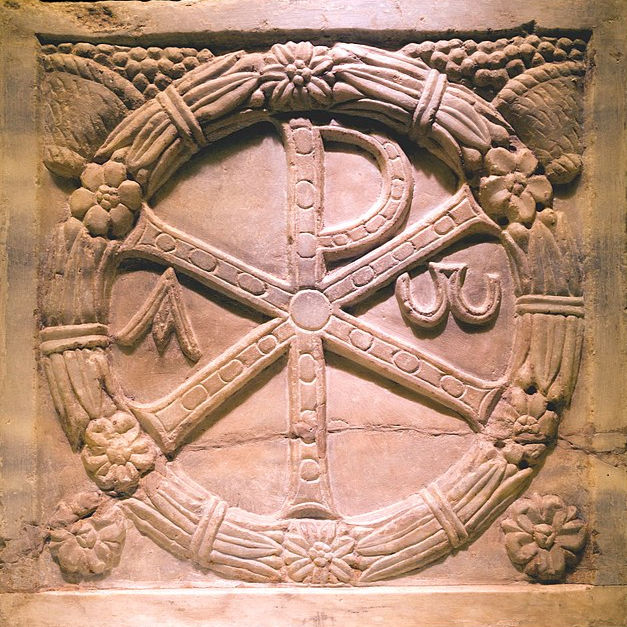
This all changed was when Emperor Constantine, raising a banner with the chi-rho symbol (representing the first two letters of Christ’s name in Greek), won a decisive victory at the Battle of the Milvian Bridge in 312 CE, which made Constantine the sole ruler of the Western Roman Empire.
Constantine utilized this banner due to his mother’s affiliation with Christianity and not because he considered himself Christian. Attributing his victory to Jesus, Constantine legalized Christianity with the Edict of Milan in 313 CE.
During the intervening decade, Constantine met with various clergy and came to realize the Christian belief system was a jumbled mess. There was no consistent agreement on what constituted orthodox Christianity, which eventually inspired him to convene the Council of Nicaea in 325 CE.
To be clear, Constantine wasn’t particularly concerned with what the church leaders decided were orthodox beliefs. All he really cared about was that they agreed on a belief system.
Although the New Testament had not yet been formally canonized, the council relied heavily on most of the documents found in our modern New Testament.
Shaped largely by the influence of Matthew, Luke, and especially John, belief in Jesus' divinity had become widespread. At the heart of the Nicene debate was the effort to clarify Jesus’ divinity (Christology) and his relationship to God the Father in a way that preserved monotheism and countered accusations of polytheism..
Once the council had developed the Nicaean Creed, the Christian religion as we know it today cemented in place. Yet, the move that fully launched Jesus’ movement into a world religion was 55 years later when Emperor Theodosius I made Christianity the official religion of the Roman Empire in 380 CE.
Like Confucianism becoming the official philosophy of the Han Dynasty, Christianity becoming the official religion of the largest empire on earth guaranteed Christianity would flourish as one of the most influential western religions for generations to come.
Conclusion: What is the Jesus Hoax?
The Jesus Hoax is the shared belief by Christians that Jesus was God incarnate—born of a virgin, Jesus lived a perfect life, died for our sins, and physically resurrected from the dead.
This entire story is the product of unintentional historical blindness.
Each subsequent generation of Christians lacked the full picture of what the previous generation believed. This became particularly acute when the second generation was tasked with writing narratives about Jesus’ life and ministry.
The bits and pieces they utilized to create the gospels prioritized theological meaning over historical precision. These narratives were not written as modern historical accounts, but as faith-formed stories intended to convey deeper truths about Jesus rather than to preserve factual accuracy.
Unfortunately, over the intervening decades and centuries, Christians lost this context and eventually began reading the gospels as direct historical accounts.
This culminated in the church holding councils that relied upon the gospels as historical documents to determine orthodox theology. Once Christianity became the state religion of Rome, there was no turning back.

The church canonized the New Testament, indicating the documents were written directly by God’s hand. As centuries became millennia, Christians believed that the Old and New Testaments of the Bible represented a literal history of the world.
This belief was first shaken by textual critics in the 19th century along with development of the scientific fields of geology, astronomy and biology.
By the mid-20th century, Western scholars had finally pieced together how Jesus' disciples had likely not believed Jesus was born of a virgin, lived a perfect life and was physically resurrected from the dead due to being God in the flesh.
This was not a conspiracy, nor a deliberate fraud, but the natural result of memory, theology, and power interacting over time. Today, when I teach my World Religions class, my job is to let them know that the tradition passed down by the Council of Nicaea is not based in history, but a constructed identity of Jesus.
They are still welcome to believe in the Jesus of tradition, as are you, but it’s important to understand, that version of Jesus is a hoax.


This study is fascinating and worthy of thought. It does not minimize ones belief in God or the Spirit of Being. Perhaps Jesus' life was one way to communicate the existence of Being, the cycle of life and the Power of Creation. Other but similar philosophies may have tried to do the same.
I recall reading about this when I decided to make a study of Christianity,, as I had studied may other things. I gave up Christianity as a result.